When you first get into radio, the terminology can feel like a different language. Words like frequency, wavelength, propagation, etc get used constantly, but they’re not always explained in a way that makes sense right away.
At the same time, there’s a bit of math behind how radio actually works. Nothing too overwhelming, but enough that understanding a few core ideas can make the whole hobby feel a lot more intuitive.
This post is meant to introduce some of the most important radio terms and the basic math concepts that tie everything together.
Frequency and Wavelength
Two of the most fundamental concepts in radio are frequency and wavelength.
Frequency tells you how many cycles a signal completes in one second, measured in hertz (Hz). Higher frequency means more cycles per second.
Wavelength is the physical length of one full cycle of that signal.
These two are related, and the relationship is based on the speed of light:
- Higher frequency → shorter wavelength
- Lower frequency → longer wavelength
A useful way to think about it is that frequency and wavelength are two ways of describing the same thing, just from different perspectives.
The connection between frequency, wavelength, and the speed of light is often written as:
c=λv
Where:
- c is the speed of light
- v is frequency
- λ (lambda) is wavelength
This equation is one of the most important in radio. It explains why antennas are sized the way they are and why different bands behave differently.

Decibels (dB)
Decibels show up everywhere in radio, and at first they can seem confusing.
A decibel is not an absolute unit. It’s a way of expressing ratios, usually in terms of power or signal strength.
Instead of saying “this signal is twice as strong,” radio engineers often express differences in decibels.
The important idea is:
- Positive dB → gain
- Negative dB → loss
For example:
- Amplifiers add gain
- Cables introduce loss
- Antennas can have gain relative to a reference
You don’t need to memorize all the formulas right away, but getting comfortable with the concept of relative change is important.
Gain and Loss
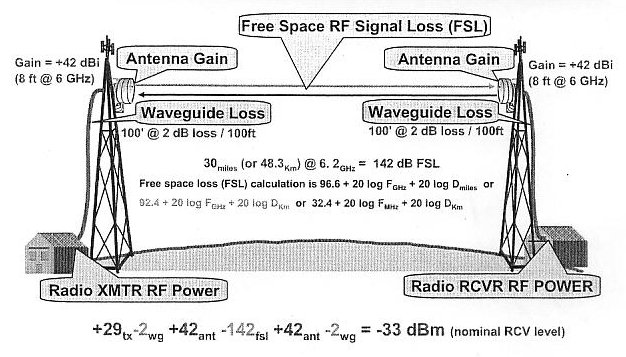
Gain refers to an increase in signal strength, while loss refers to a reduction.
These concepts apply to many parts of a radio system:
- Antennas can have gain depending on their design and directionality
- Feedlines introduce loss as the signal travels through them
- Connectors and components can also affect overall signal strength
Understanding where gain and loss occur helps you evaluate your setup more effectively.
Power and Signal Strength
Power in radio is typically measured in watts. Transmit power determines how strong your signal is when it leaves the transmitter.
However, more power doesn’t always solve every problem. Antenna efficiency, propagation conditions, and system losses all play a role in how your signal is received.
This is why a well-designed antenna system can often outperform a higher-powered setup with poor efficiency.
Standing Wave Ratio (SWR)
Standing Wave Ratio, or SWR, is a way to check how well your antenna matches your radio and feedline.
When everything is well matched, most of the signal your radio sends out goes into the antenna and is transmitted into the air. When there is a mismatch, some of that signal gets reflected back toward the radio instead of being radiated. SWR gives you an idea of how much of that reflection is happening.
A low SWR (close to 1:1) means your antenna system is well matched and working efficiently. A higher SWR means more signal is being reflected, which usually means your setup could be improved or adjusted.
In practice, SWR is a very important factor to understand whether your antenna is tuned properly and whether your radio is able to send power out effectively.

Why This Is Important
You don’t need to be a mathematician to enjoy radio, but having a basic understanding of these concepts helps you make better decisions.
Instead of guessing, you start to understand why:
- Certain antennas perform better than others
- Some frequencies work better at different times
- Signal strength changes in ways that aren’t random
It turns the hobby from something like transmitting on public channels on a walkie talkie into something you will truly understand and enjoy.
Radio becomes much more interesting once the underlying ideas start to make sense. Frequency, wavelength, power, and decibels aren’t just abstract terms—they describe how signals move, interact, and behave in the real world.
You don’t need to learn everything at once. Even a basic grasp of these concepts is enough to improve your understanding and help you get more out of your setup.
Over time, these ideas start to feel less like theory and more like second nature.